-The government’s PR narrative has become so worn-out and predictable that it has devolved into a tasteless caricature.
The Maximos Mansion’s methodology is well-known and hackneyed: whenever the government wants to push through a harsh, socially callous policy, it puts forward a “stalking horse”—an MP or minister—to float the most extreme version of that policy.
The “stalking horse” tactic and collective responsibility
They let the uproar build and gauge the public reaction; then, like a *deus ex machina*, a more moderate representative of the party steps in to lower the temperature, assuring everyone that “this is not the government’s official position.” In practice, however, the seed has already been sown, and the plan proceeds as intended.
The latest instance of this government charade played out in exactly this manner. Pavlos Marinakis took on the role of the “stalking horse,” tossing out the infuriating trial balloon that unemployment benefits should not last longer than two months. The following day, Konstantinos Kyranakis kept the narrative going with the perfect pretext: the claim that many “bad citizens” work off the books while simultaneously milking the state for benefits. This is a crude, cynical provocation, given that the government’s narrative is built on the logic of collective responsibility. Because the state itself is unable (or unwilling) to crack down on undeclared work and the few unscrupulous actors exploiting the system, it chooses to punish the entire struggling class of the unemployed en masse, slashing their already meager safety net.
The message has been received—and at a perilous juncture, no less, with behind-the-scenes discussions regarding cuts to unemployment benefits already underway.
The AI Challenge and the Prime Minister’s Hypocrisy
The problem, however, is not merely ethical; it is strategically shortsighted and dangerous for the nation. At the very moment New Democracy is paving the way—or at least testing the waters—to drastically reduce unemployment coverage, the rest of the world is preparing for the exact opposite.
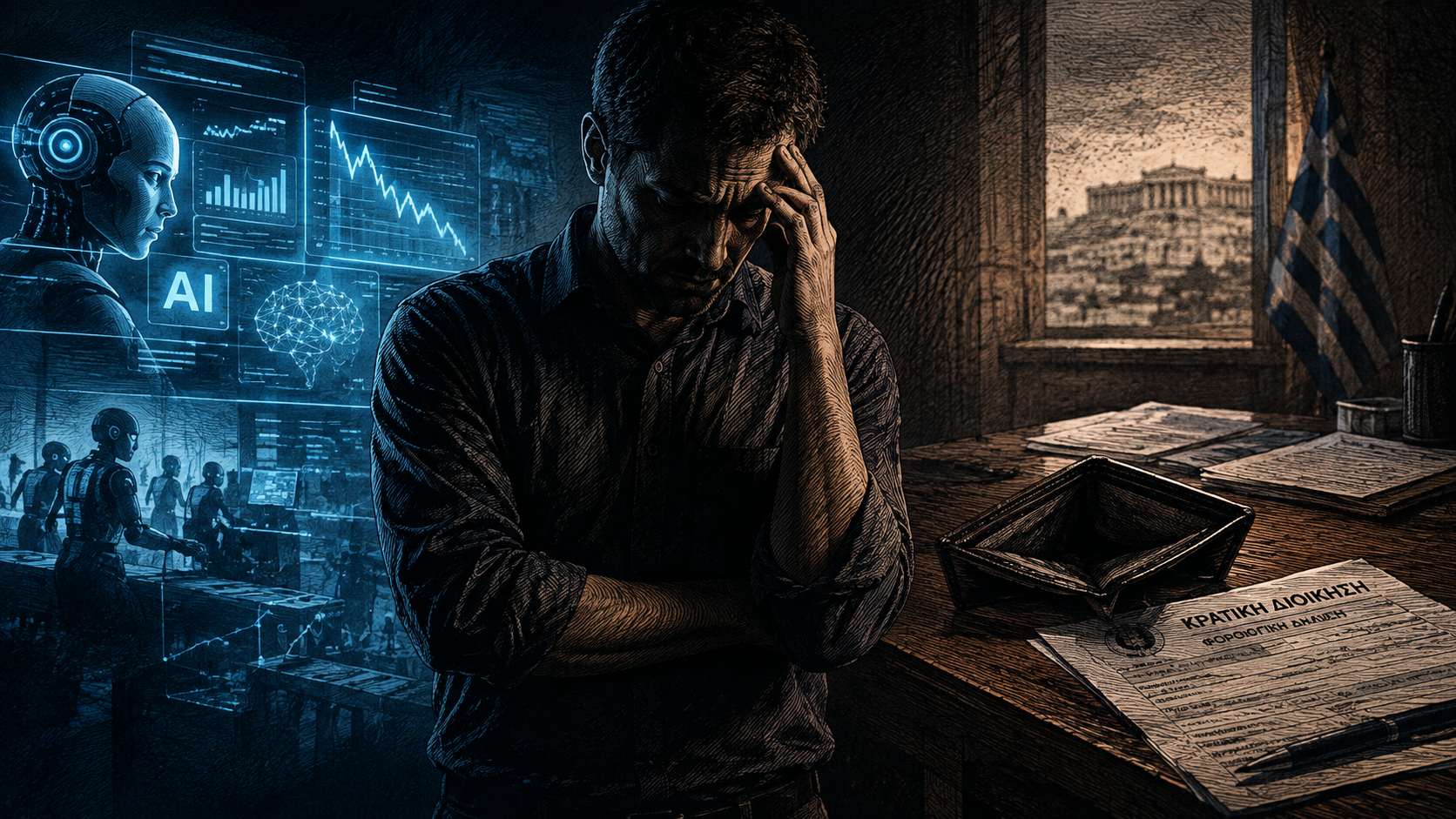
The global discourse on artificial intelligence (AI) converges on a harsh truth: AI will exert unprecedented pressure on the labor market and cause structural unemployment, sweeping away entire professional sectors. Even Kyriakos Mitsotakis himself, pressed by international realities, was recently forced to admit that “the greatest challenge of all is the massive loss of jobs” due to artificial intelligence.
He even warned that, within three to five years, roles such as those in call centers “may no longer exist.” Here, then, hypocrisy reaches a peak: If the Prime Minister himself admits we are facing rapid job losses, how can this be reconciled with a policy that hints at cutting protections for the unemployed?
How is it that, precisely now—as these risks loom larger than ever—the state is preparing to step aside?
International trends versus the Greek reality
Globally, from Bill Gates to leading American and European institutes, the central question is how to strengthen the welfare state. Discussions focus on increased benefits, mass retraining programs, and even special taxation (a “robot tax”) on companies that replace workers with algorithms. Yet, in the Greece of 2026, we hear officials from the ruling party calling for… the axe to fall on the two-month benefit, citing the presence of “opportunists.”
This amounts to more than mere inconsistency. It is the epitome of a covert government doctrine they dare not admit: on one hand, they celebrate growth figures and the influx of billionaires seeking tax havens on the evening news; on the other, they dismantle the welfare state, hiding behind the convenient narrative of the “bad citizen.”
If the government believes even a word of what the Prime Minister says regarding the epoch-making changes brought about by AI, it has a fundamental national responsibility to safeguard—not gut—labor protections.
It should not be inventing cheap excuses to cast the many into the abyss for the sake of the few. For beneath the smokescreen of PR stunts, the essence of their policy remains unchanged: the “bad citizen” is—and always will be—to blame for everything, never the authorities who leave that citizen defenseless against the coming storm.
TO PARON