
Writes
PERIKLIS NEARCHOU
Ambassador emeritus
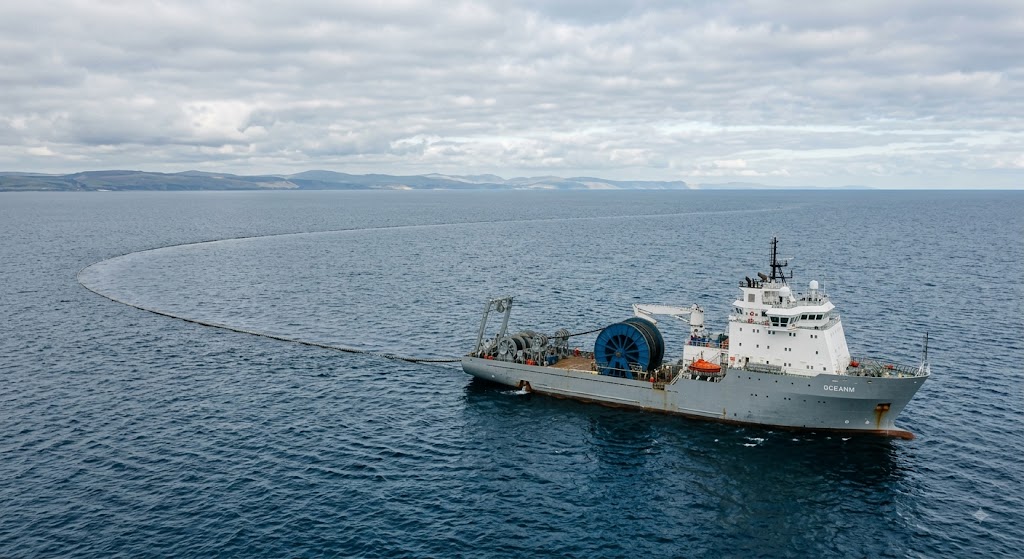
The large French company Meridian, specialized in large energy interconnection projects, entered the share capital of the company that promotes the electricity interconnection of Greece – Cyprus, as part of the strategic Europe – Asia electrical interconnection pipeline (GSI). Specifically, it took 51% of the shares from ADMIE.
This move by the French company, which has the strong support of the French government of the French President, resolves the issues related to the economic viability and technical conditions of the project. It simultaneously highlights the European dimension of the project and adds in particular the weight of France to its smooth progression and implementation.
It remains, nevertheless, the question if this time too Ankara tries to intervene, with the narrative of the “Blue Homeland”, how Greece will react and defend its rights.
The precedent of Kasos in 2020 causes sadness and indignation. Greece allowed Ankara to cancel the laying of the research cable, with the argument that this area supposedly constitutes part of the Turkish “Blue Homeland” and that for the conduct of any research, permission from the Turkish authorities is required.
Obviously, Ankara seeks to create accomplished facts and to dynamically impose, on the field, its outrageous demands for a Turkish continental shelf and EEZ. In this spirit, it had also announced the conversion of the “Blue Homeland” into a law of the state, so as to make its imposition internal law and to bind the Turkish political system to it. On the occasion of the NATO Summit in Ankara, it postponed the voting of the relevant bill in the Turkish National Assembly, waiting for the suitable conjuncture to bring it back.
This Turkish move clearly shows that the time of postponement by Greece of the exercise of its legal rights, which derive from the international law of the sea, has been exhausted. In the same way, the baseless policies of appeasement have been exhausted, which allow Ankara not only to maintain intact its absurd claims at the expense of Greece and Cyprus, without paying a heavy price, but also to provocatively escalate its demands. It reached the point today of openly demanding half the Aegean, beyond the 25th Meridian, and the ownership of scattered islets in the Aegean, with the argument that these are supposedly of undetermined sovereignty.
Greece no longer has any margin of postponement and referral to the future of the exercise of its rights, trapping itself at 6 miles, which are today its territorial waters. Even these are not respected by Ankara for fishing in the Aegean. Turkish fishermen, with the encouragement and cover of the Turkish state, systematically invade Greek territorial waters and violate throughout the Aegean the regulations established by the European Union for the protection of marine fry.
Why does the Greek government passively tolerate this situation? Why does it not defend the interests of Greek fishermen and the protection of the marine environment, for which it also has the support of the European Union? The defense of Greek rights on the issue of the laying of the required cables for the electricity interconnection pipeline of Greece – Cyprus and Europe – Asia far exceeds in significance this important project. It directly concerns the strategic position and role of Greece in the Eastern Mediterranean.
Ankara wants to trap Greece in the western half of the Aegean and essentially marginalize it strategically, taking over itself the strategic control of the Eastern Aegean and adding its strategic value to that of the Straits, which it controls. With this scenario, Greece is also pushed out of the Eastern Mediterranean, in which Ankara wants to impose its hegemony.
Is Israel, however, willing to allow Ankara to intervene in its communications with the West and to establish hegemony in the Eastern Mediterranean? Is France willing to tolerate such a Turkish hegemony, when its interests in the Middle East and particularly in Lebanon are directly affected?
Greece, in the defense of its maritime rights and its presence in the Eastern Mediterranean, has strong strategic allies, beyond the European Union, which sees in Greece and Cyprus two member-states that constitute its border in the region and platforms of European policy for it. Taking also into account the American policy for the Eastern Mediterranean and the Middle East and especially its connection with the security of Israel, it is obvious that neither do the USA favor Turkish hegemony in the Eastern Mediterranean.
Greek policy therefore has strong foundations for a more active and decisive projection and exercise of its rights. It is not an extreme policy the exercise of the rights determined by the international law of the sea and which have been exercised by almost all the affected countries, with the sole exception of Greece.
In this spirit, Greece must leave behind the precedent of Kasos and react dynamically in the event of Turkish obstruction of the foreseen researches for the GSI pipeline. In the same spirit, it must take initiatives for the gradual exercise of the EEZ rights, territorial waters and protected maritime zones of Greece, as well as the fishing rights in the Aegean.
Turkey uses, as is known, the threat of power. It is therefore an existential issue for Greece the creation and preservation of a strong deterrence, which will not allow Ankara to make plans for the snatching of the Aegean and the strategic marginalization of Greece. The current Turkish President has long been planning to secure for Turkey unquestionable military superiority against Greece and to take, from a position of strength and without a fight, what he wants from Greece. These plans went back with the adventure of the S-400 missiles and the F-35 aircraft. Ankara, however, does not resign from these plans and intensifies its efforts in the field of the national war industry.
Greece must not only monitor Turkish armaments and maintain a necessary balance. It must simultaneously develop its own defense industry, technology and innovation and build complementarily the necessary strategic collaborations and alliances.
Greece is not as powerless as some think, nor is Turkey as powerful as it wants to present itself. Ankara projects a grandiose strategic and hegemonic plan, in which however the contradictions and reactions multiply. Erdogan is now trying to close the front of the Kurds, which is particularly dangerous as the tension and confrontation between Turkey and Israel sharpen. The plan is not new. He had projected it and had tried to apply it at the beginning of his political term. He was forced, however, to abandon it in the face of strong nationalist reactions in the National Assembly and in the Army. Today he has the advocacy and support of his political partner in the government, the nationalist Bahceli. The bill, however, which he introduces in the National Assembly remains very restrictive, excluding from the amnesty the PKK fighters who acted against the Turkish security forces and Ocalan himself, who will remain in prison.
Ankara seeks through the “solution” of the Kurdish issue to prevent its instrumentalization by foreign powers (see Israel) but also to use the normalization of relations with the Kurds for the expansion of Turkish influence on the Kurds of Syria, Iraq and Iran. Personally, the Turkish President Erdogan also seeks to utilize the Kurdish vote to change the Constitution and make possible his own new Presidential term.
The basic decision that Turkish policy experiences is the projection, on the one hand, by Turkey of an Islamic vision as the dominant ideal of Turkish policy and the motor of the megalo-ideatic Turkish ambitions and, on the other hand, of a Western, NATO identity, which connects Turkey with the USA and Europe.
The real weakness of Greece against Turkey is the deficit of strategy and decisiveness that characterizes its leadership. An example today is the new initiative for the Cyprus issue of the outgoing UN Secretary General Antonio Guterres. Athens and Nicosia rushed to welcome the initiative, without reflecting on the framework within which it is expected to manifest. This framework was essentially delimited by the Secretary General, during his visit to Nicosia. The epicenter was not the Turkish invasion. This is silenced and the inter-communal aspect of the Cyprus issue is projected, which leaves Ankara out as an invader.
If the Guterres initiative continues and reaches the submission, either by himself or by his personal envoy for the Cyprus issue, Holguin, of a plan for the “solution” of the Cyprus issue, what will be its content? There is already talk, with leaks to the British and Turkish Press, of a “loose federation”, a pseudonym for the demand by the Turkish side of two confederated “equal” parts or two states. Can Cyprus accept or does it have an interest in accepting such a “solution”? The dissolution of the Republic of Cyprus and its replacement by a two-headed state, which will be governed with a Turkish veto, would be a self-destructive solution for the Hellenism of Cyprus, but also for the whole of Hellenism.
Cyprus, today, with the initiatives it has taken during the last period, has substantially strengthened its position. The balance of power is no longer the one established by Ankara in 1974, with the invasion. This course must continue and be further strengthened and not be overturned by the dissolution of the Republic of Cyprus and the subjection of the entire Cyprus now to Turkish geopolitical control.
TO PARON
Photo: Digital depiction / paron.gr